
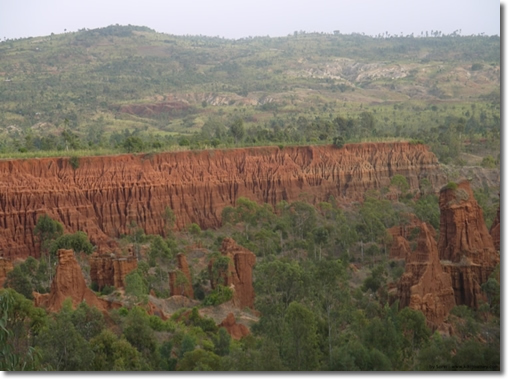
 The town Konso located at the entrance to the Omo Valley. The Konso people live in an isolated region of the basalt hills made up of hard rocky slopes. Konso village is fortified by a stone wall used for defensive measure. Their village is located on hilltops and is split up into communities, with each community having a main hut. In order to enter a Konso village, you must pass through a gate and a series of alleys. These paths are part of its security system makes the village difficult to access.The erection of stones and poles is part of the Konso People tradition. A generation pole is raised every 18 years, marking the start of a new generation. The age of a village can be determined by how many poles are standing. Carved wooden statues are also used to mark the grave of a famous Konso tribal member. The marker, called a Waga is placed above the grave and smaller statues are then placed around the larger one representing his wives and conquered enemies.
As so often happened around the world, the women maintained the traditional ways. Konso women wore skirts that looked double layered. One ruffled skirt stopped at the hips. The second layer went to mid-calf. Favorite style was white cloth with a multi-colored trim. How the Konso women wore their blouses depended on the amount of work to be done, and the Konso people were hard workers! Many of the mountains in the region had been terraced. If the women weren’t working too hard, they wore their blouses the regular way. But, it they worked up a sweat carrying enormous loads on their backs, they frequently just pulled the blouse over their heads letting them (and anything else) hang down the front.
They are mixed agriculturists using their dry and infertile lands to grow crops. Animal dung is used to fertilize the land and most important crop is the sorghum, beans, cotton, corn and coffee. Sorghum is used as flour and to make local beer.